
- (Introduction)
- Surface gravity waves, crucial for sediment transport in coastal regions, undergo wave modulation owing to local hydrodynamic conditions.
- The causes of wave modulation are known to be currents in narrow channels and offshore regions and changes in water depth in nearshore regions.
- Therefore, this study aimed at determining the impact of depth and current on wave modulation in Gyeonggi Bay and estimating the site-specific dominant factor.
• However, the primary factor of wave modulation can vary locally depending on the hydrodynamic conditions, and studies on understanding the spatiotemporal distribution of causes have not been widely conducted.
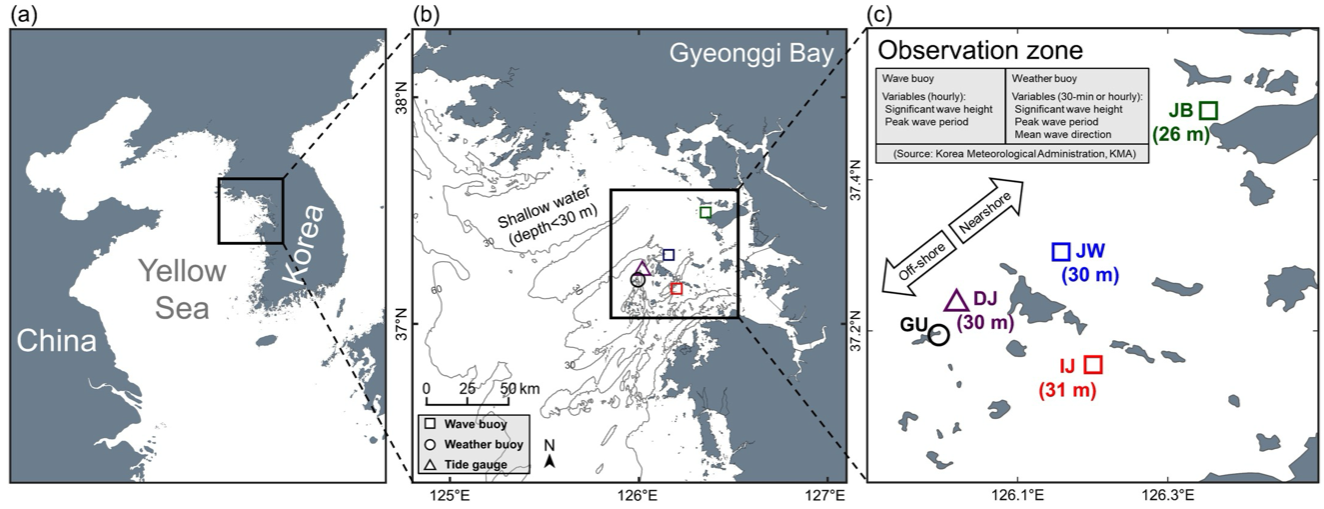
(a) Location of Gyeonggi Bay (GGB) in the eastern part of the Yellow Sea. (b) Bathymetry contours (m) of the GGB, along with five observation points: i) three wave buoys (square) at Ijakdo (IJ), Jawoldo (JW), and Jangbongdo (JB); ii) one weather buoy (triangle) at Duckjuckdo (DJ); iii) one tide gauge (circle) at Gulupdo (GU). (c) The observation zone and the numbers below the buoys indicate the water depth at each buoy.
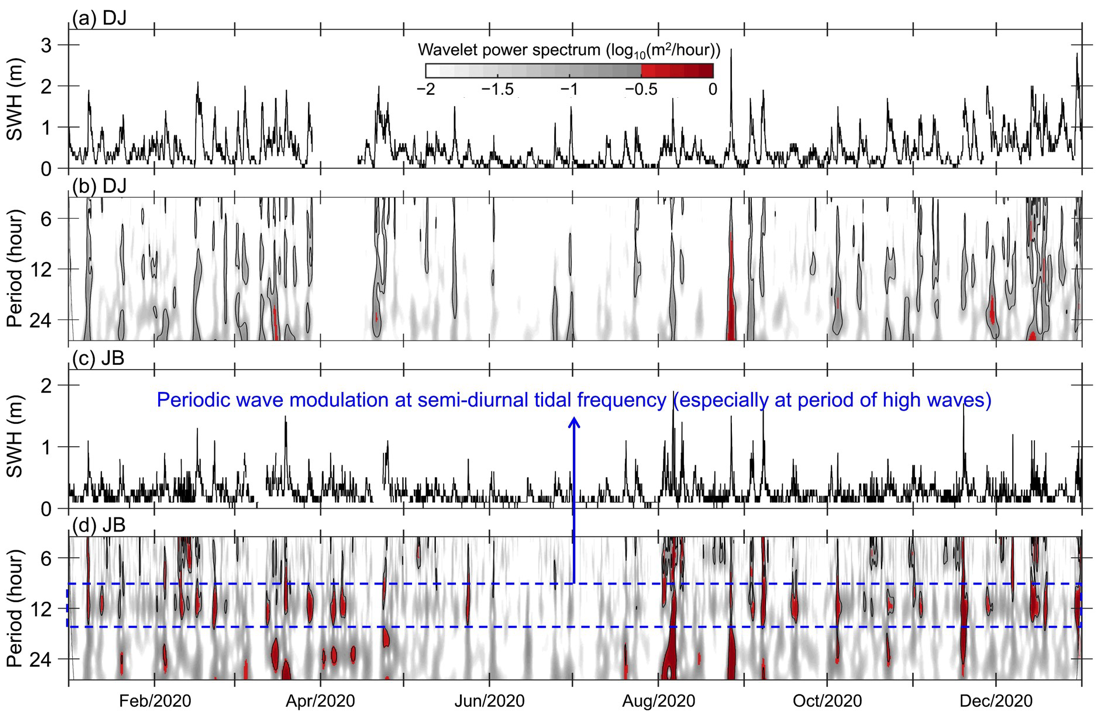
Comparison of the observed wave modulations at DJ weather buoy and JB wave buoy. (a) and (c) Time series of significant wave heights (SWH) observed in 2020. (b) and (d) Wavelet power spectrum for the SWH observed including a semidiurnal band (12 h, two cycles per day). The black lines in (b) and (d) enclose regions of 95% significance level for the calculated wavelet power spectra. Note that each power spectrum was normalized by its standard deviation for the comparison purpose.
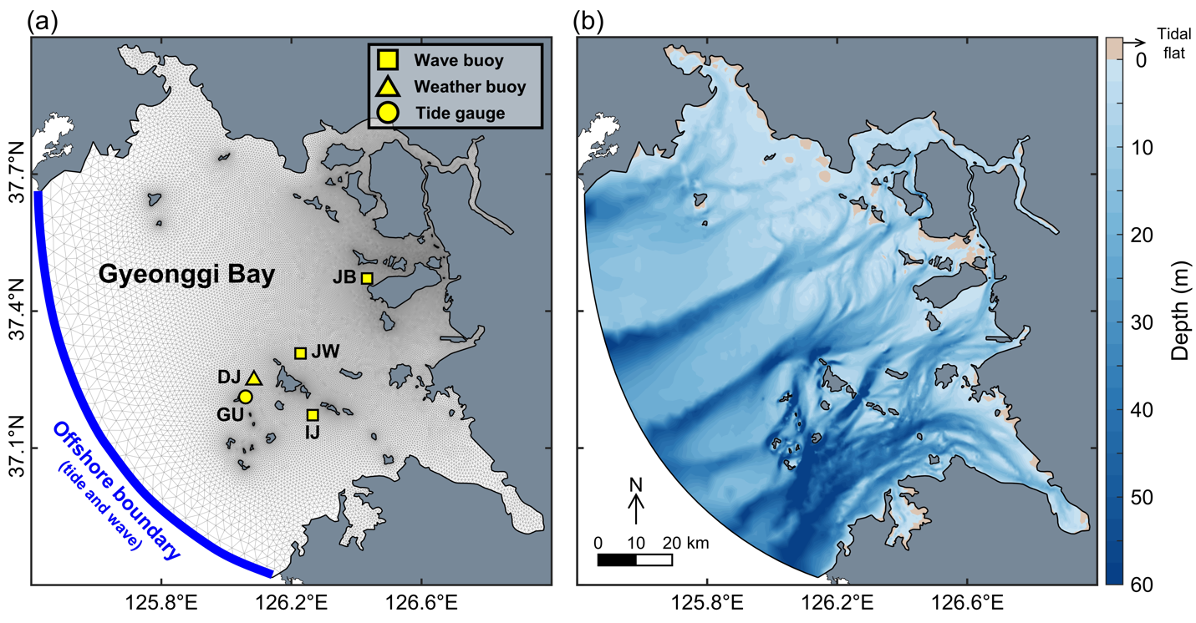
(a) Model grid system and observation points. The blue line indicates the model offshore boundary where the boundary conditions of the tide and wave are entered. The observation points consist of three wave buoys, one weather buoy, and one tide gauge. (b) Model bathymetry based on the mean sea level. The gray shaded area is the area where the water depth is less than 0 m with respect to the mean sea level, and the tidal flat is distributed.
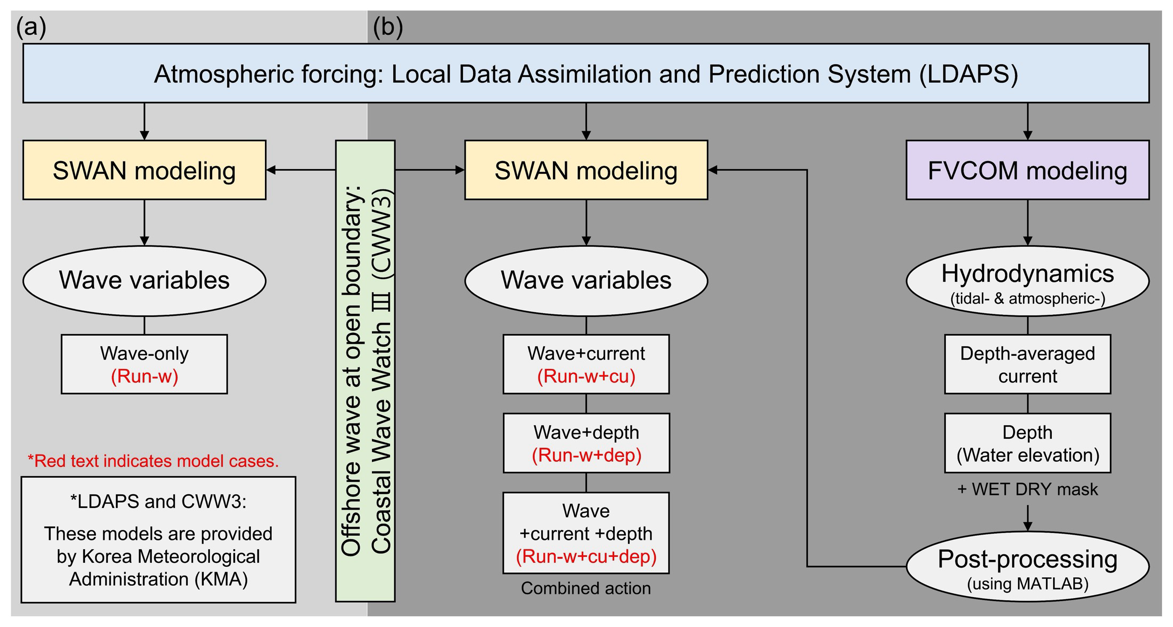
Flow chart of a modeling system for analyzing wave modulation in GGB: (a) Wave-only simulation using Simul-ating WAves Nearshore (SWAN); (b) Wave simulation under hydrodynamic conditions (current, depth, and combined action). The hydrodynamic conditions are derived from Finite Volume Community Ocean Model (FVCOM). Atmospheric and offshore wave forcing at model boundaries are from model data provided by the Korea Meteorological Administration.
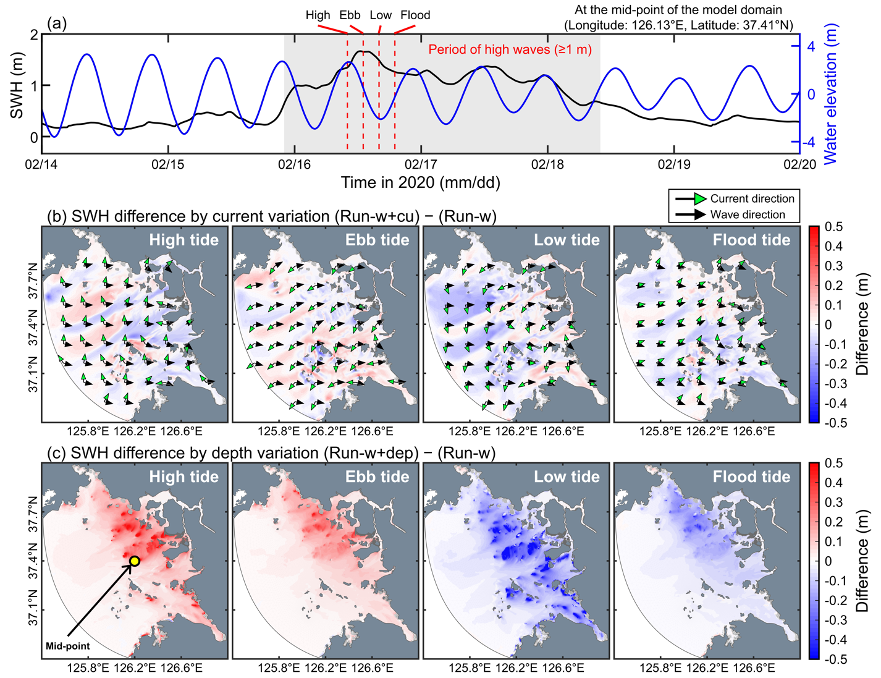
(a) Modeled SWH and water elevation time series at the mid-point (first figure in (c)) of the model domain during the model simulation period. The gray shaded area highlights the period of high waves, and the red dashed lines indicate each tidal phase (high, ebb, low, and flood tide). (b) and (c) represent the difference in SWH due to changes in depth and current according to each tidal phase. The magnitude of differences is expressed in color. The red (blue) color indicates that the SWH is increased (decreased) by depth and current. The green (black) vector indicates the current (wave) direction in (b).
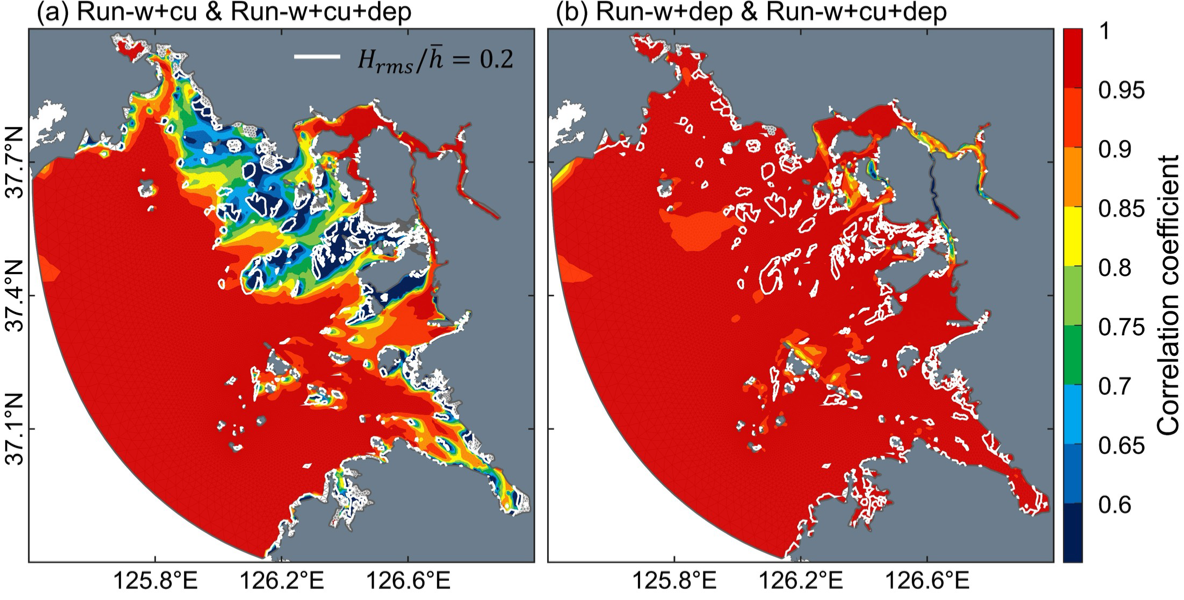
Cross-correlation coefficients between the modeled SWH. The white line indicates the wave height to water depth ratio (root mean square wave height to mean water depth ratio, H_rms / h) is 0.2. (a) and (b) show the spatial relationship between the effect of current/depth on the SWH, respectively. The calculation of the correlation coefficients was performed during a period of high waves.
(Summary)
• In the coastal regions of Gyeonggi Bay, characterized by a macro-tidal environment, the dominant factor for wave modulation was identified as depth changes due to tides.
• Wave modulation due to tides was primarily observed in the surf zone, where the depth changes significantly according to the tidal phase (particularly high tide and low tide).
• The wave modulation in the nearshore regions cannot be explained solely by changes in currents. The depth changes were clearly identified as the main cause of wave modulation based on the ratio of wave height to mean depth (Hrms/h̅) reaching 0.2.
• Conversely, changes in currents were found to determine the characteristics of wave modulation in narrow channels.
• This study highlight that the spatio-temporal distribution of wave modulation in a macro-tidal environment can significantly impact various estuarine dynamics, including sediment transport.
(Reference)
Kim, K.H., Kim, M.S., Lee, H.M., Kim, M.H., Woo, S.B., 2023. Dominant factors responsible for wave modulation in the macro-tidal Gyeonggi Bay of the Yellow Sea. Ocean Eng. 287, 114875. https://doi.org/10.1016/j.oceaneng.2023.114875.
- 사업명
- 씨그랜트사업 5단계
- 발주처
- 해양수산부