
- We developed an automated QC using 344 CTD casts near New Port, Incheon.
- Our model detects more outliers than Traditional QC and IF-basic.
- Our model achieved the best ROC/PR and confusion-matrix performance.
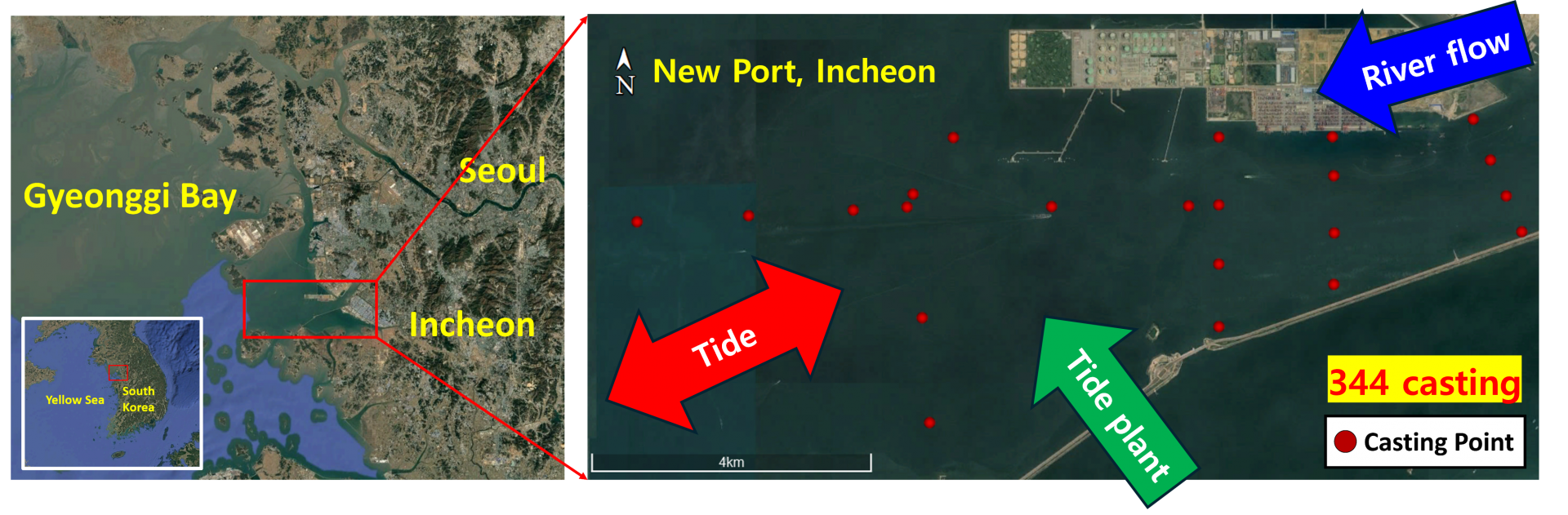
Figure 1. Study area and CTD casting stations near New Port, Incheon (Gyeonggi Bay). Red dots indicate CTD casting locations. Major hydrodynamic drivers in the area—tide, river inflow, and the influence of a tidal power plant—are annotated to provide environmental context for the observations.
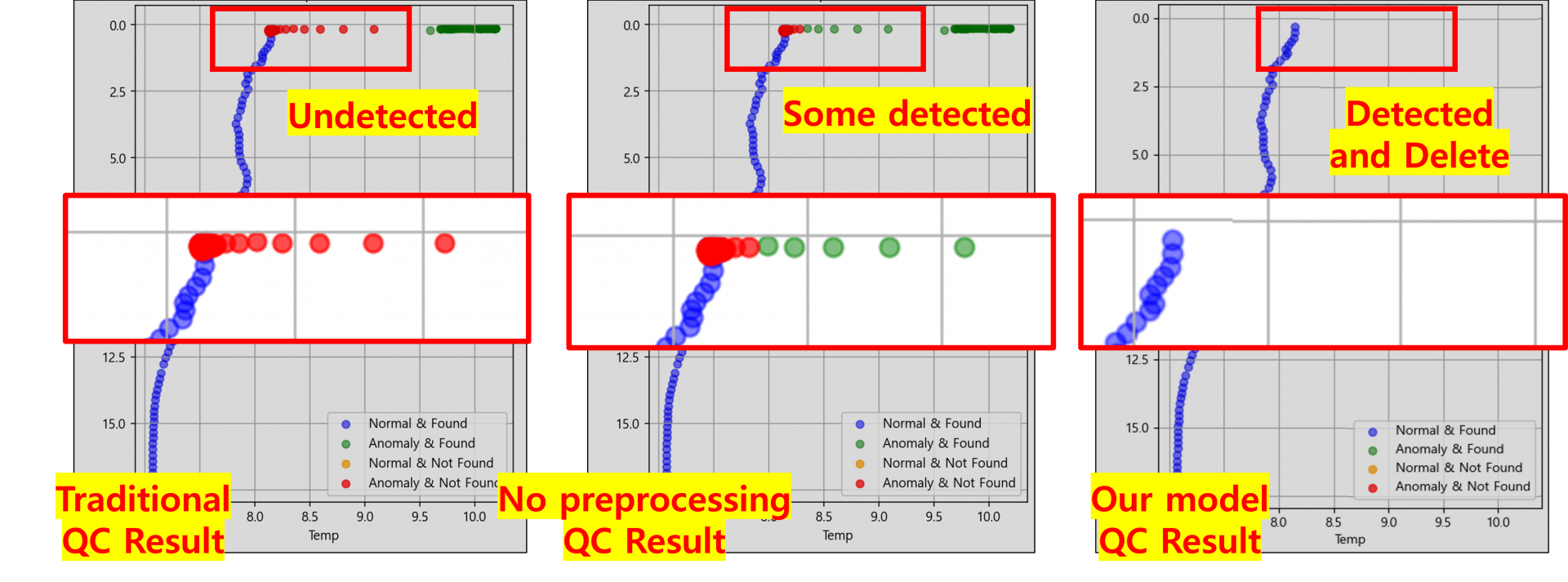
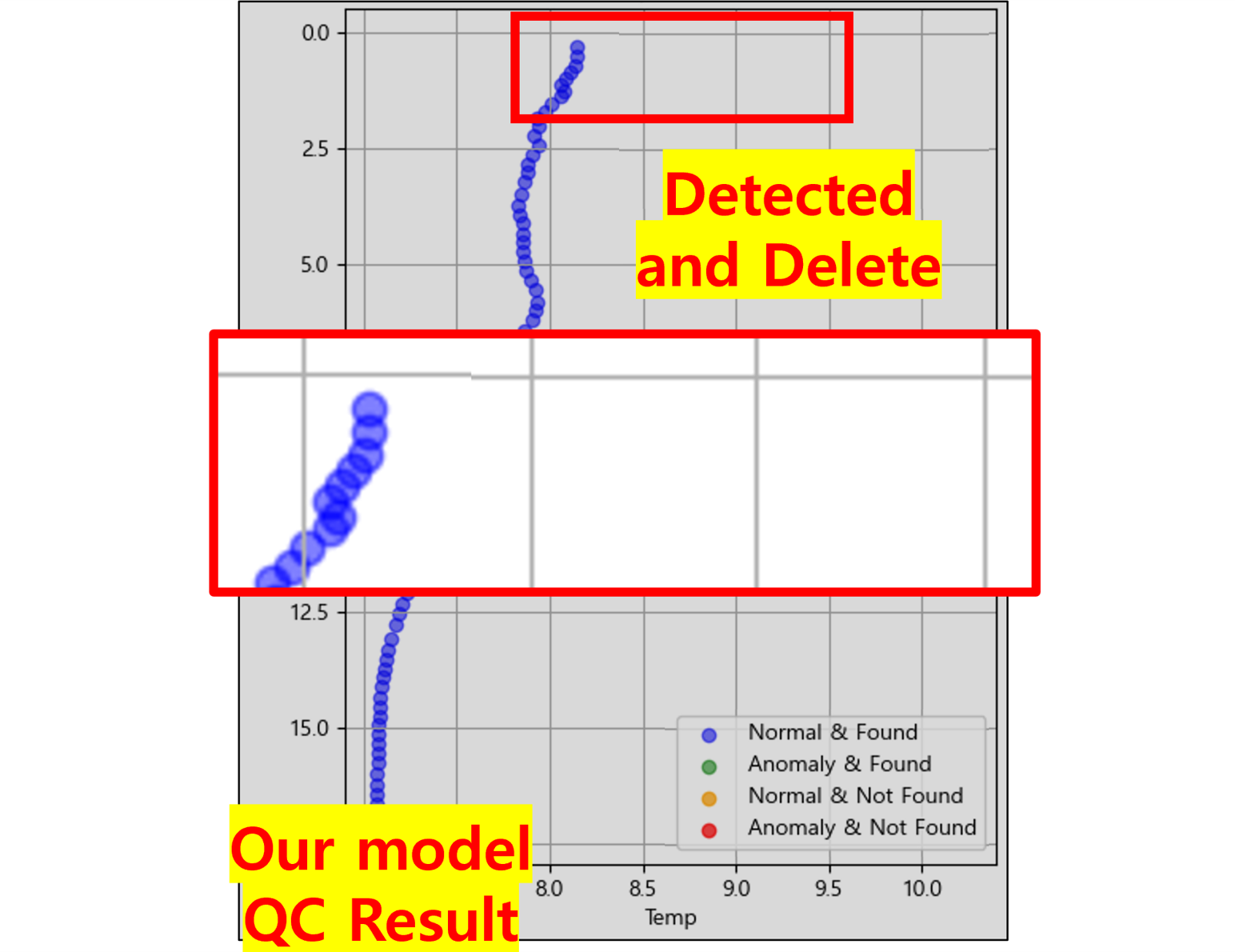
Figure 2. Comparison of outlier detection results for a single CTD profile across QC approaches (traditional QC vs. model without preprocessing vs. our model). Left: Traditional QC fails to flag surface-layer outliers. Middle: The model without preprocessing detects some outliers but still misses others. Right: Our preprocessing-based model consistently detects and removes surface-layer outliers.
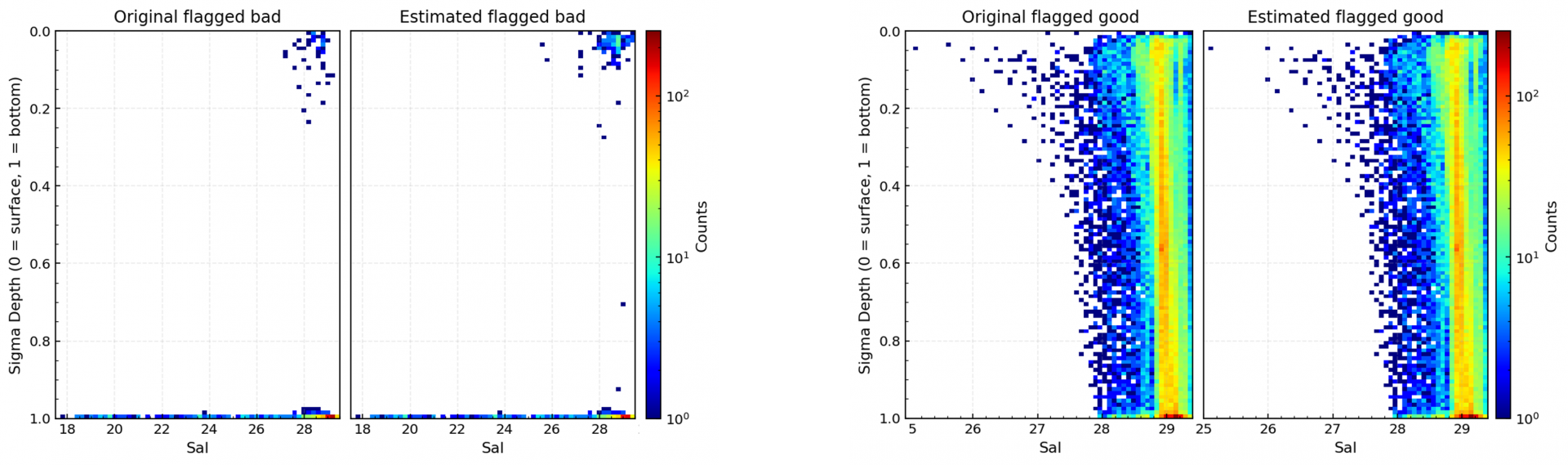
Figure 3. Distribution of QC flags in salinity–sigma depth space (original flags vs. model-estimated flags). The two left panels show samples flagged as bad, and the two right panels show samples flagged as good.
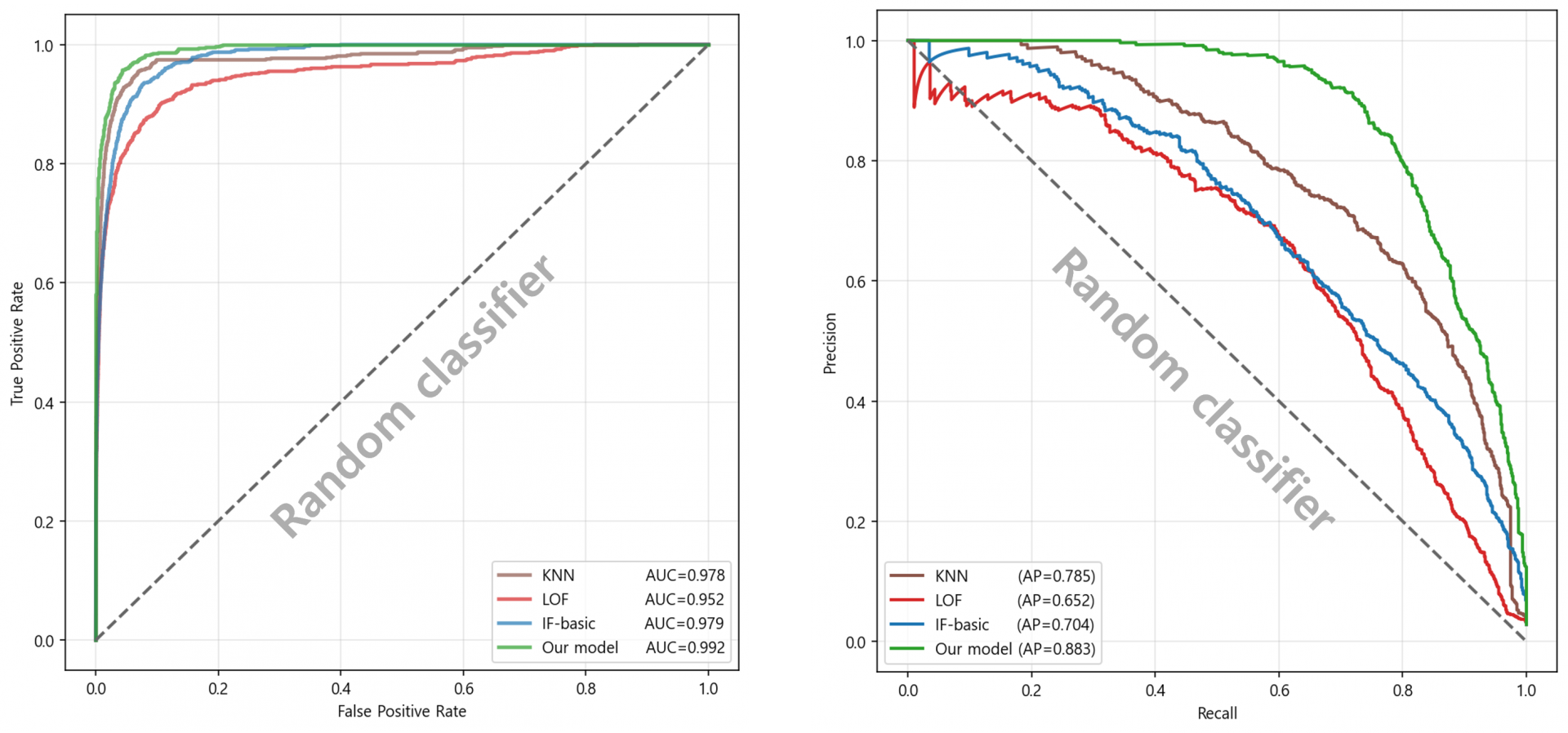
Figure 4. Performance comparison of outlier detection models using ROC (left) and Precision–Recall curves (right). We compare KNN, LOF, a basic Isolation Forest (IF-basic), and our proposed model. Our model achieves the best performance in terms of ROC-AUC and Average Precision (AP).
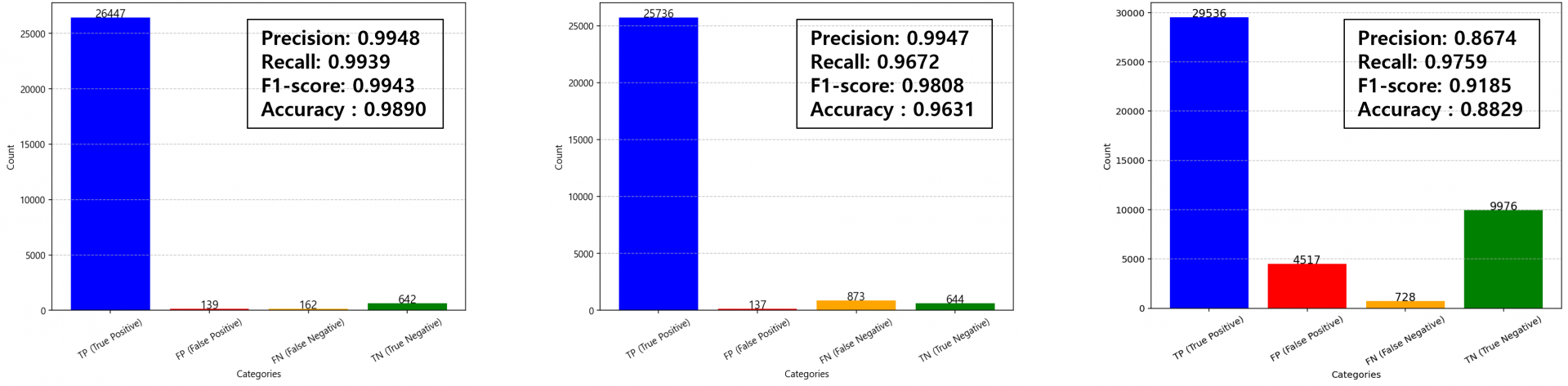
Figure 5. Performance comparison across QC approaches using confusion-matrix breakdown (TP/FP/FN/TN) and key metrics (Precision, Recall, F1-score, Accuracy). Left: Our model, middle: IF-basic, right: Traditional QC. The proposed model reduces both false positives and false negatives, achieving the best balance between precision and recall and the highest overall F1-score and accuracy.
Coastal CTD measurements are strongly affected by tides, river inflow, and anthropogenic influences (e.g., a tidal power plant), leading to rapid spatiotemporal variability and frequent measurement artifacts, especially near the surface and bottom due to sensor stabilization, profiling motion, and near-bottom disturbances. Using 344 CTD vertical profiles collected near New Port, Incheon in Gyeonggi Bay, we developed a preprocessing-based automated QC framework (Our model) built on an Isolation Forest outlier detector tailored to coastal conditions. In an example case, Traditional QC failed to flag some surface-layer outliers, and IF-basic improved detection but still missed anomalies because unstable segments distorted the data distribution. In contrast, our model mitigates these effects through preprocessing and feature design, enabling more consistent detection and removal of coastal CTD outliers. ROC/PR analyses and confusion-matrix summaries confirm that our approach reduces both false alarms and missed detections, achieving the most robust and balanced QC performance among the compared methods.
DOI Link: -
- 사업명
- 연안 빅데이터 플랫폼
- 발주처
- 한국지능정보사회진흥원